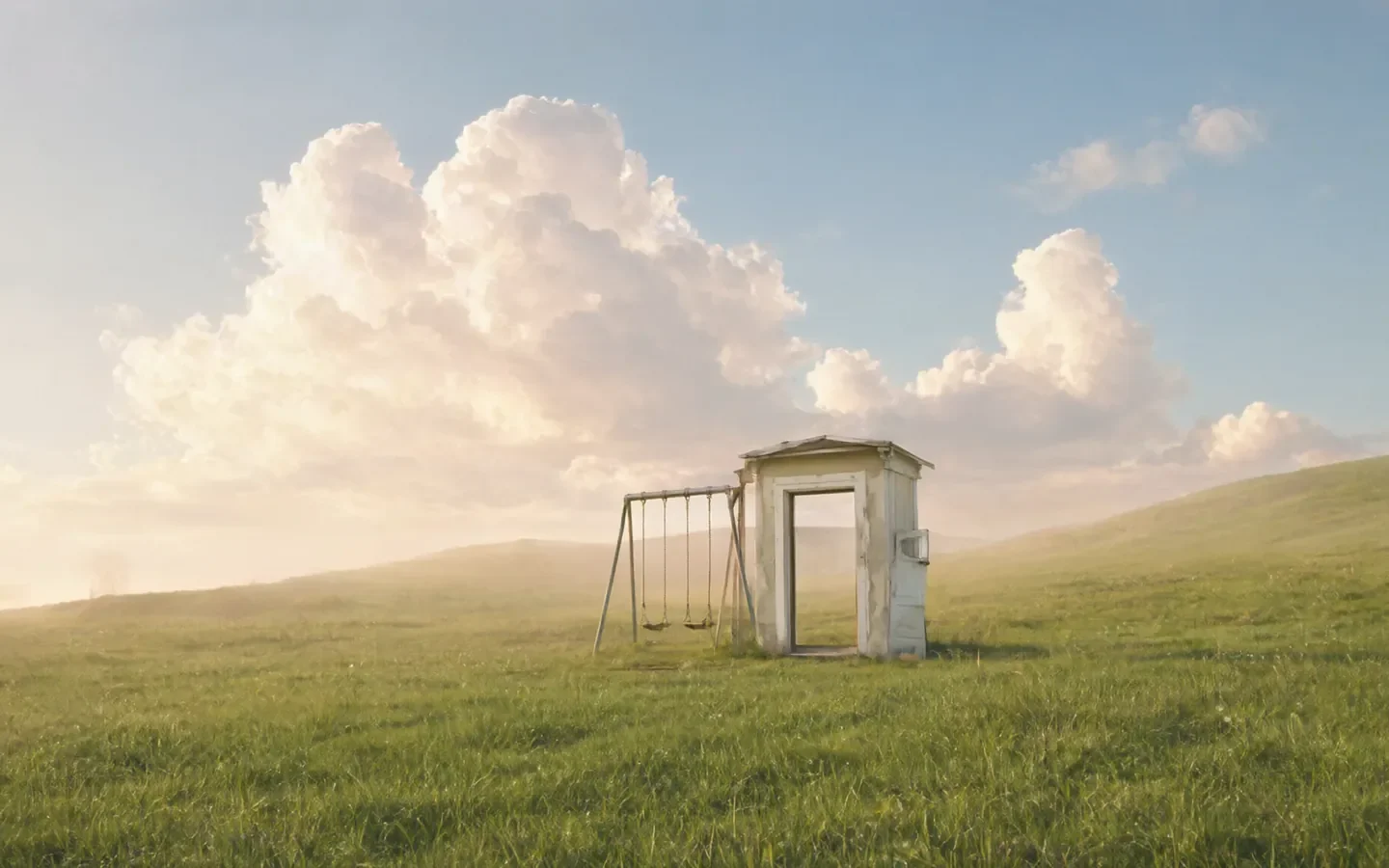
A solitary white clapboard house sits atop an impossibly smooth green hill beneath towering pastel clouds. Shadows fail to fall where afternoon glare predicts, a freestanding doorframe opens onto golden mist, and a stark caption floats overhead asking whether you remember arriving. Welcome to Dreamcore—an internet visual and musical subculture built to render the elusive grammar of sleep, childhood memory, and altered realities.
Closely linked with the architectural archive of liminal space, Dreamcore shifts focus from stark architectural observation toward subjective interiority. Instead of presenting an unedited documentary shot of an empty corridor, it saturates, blurs, stitches, and animates familiar places until everyday geography obeys dream logic rather than waking physics.
What Is Dreamcore? Surrealism, Detachment, and Dream Logic
Dreamcore meaning rests on an emotional blend of gentle escapism and subtle estrangement. Curators and scholars—including Jia-Yu Song, Won-Ho Choi, and Ru L. in their SAGE Journals study What Makes People Like Dreamcore Aesthetics?—note that the aesthetic simultaneously evokes comfort, relaxation, and wistful nostalgia alongside mild depersonalization, derealization, and detachment from daily structure.
Many newcomers mistake Dreamcore for a horror genre. Although voids, unsettling questions, or macabre touches surface in darker edits, dread is never essential to the style. Numerous defining works feel tender, whimsical, or bittersweet, capturing the moment right before waking when an illogical hillside or playground still feels reassuring. Equally characteristic is direct address: videos and collages routinely break the fourth wall to speak to “the dreamer,” folding the audience inside the scene.
Perceptual research helps explain why bent familiarity grips viewers so effectively. Research published in 2022 by psychologists Alexander Diel and Michael Lewis showed that subtle structural deviations from familiar built environments trigger an uncanny-valley response—the same tension documented in Peter Heft’s commentary on Mark Fisher’s “failure of presence” in empty schools and corridors, here softened by surreal color and personal memory.
Evolution From 2018 Tumblr to the 2026 Revival
No solitary founder launched Dreamcore; the subculture coalesced collectively across decentralized social feeds, drawing on visual motifs circulating since the early internet era. While the label itself crystallized in the early 2020s, early visual touchstones trace back to 2018 on Tumblr, where artist Gabrielle Traversat (@gbrltvrst) shared surreal landscapes paired with 3D elements that helped shape its hazy digital tone.
Popularity accelerated rapidly alongside the March 2020 lockdown spike in empty-space imagery across Tumblr, TikTok, YouTube, and Reddit—the wider liminal surge that lifted r/LiminalSpace past 500,000 members, @SpaceLiminalBot on Twitter past 1.2 million followers, and #liminalspaces past two billion TikTok views by November 2022. Short compilations tagged #Dreamcore layered blurred childhood landscapes over ambient audio, boosted by YouTube channels like mother is watching and Kane Pixels’s Backrooms shorts. Around 2021 and 2022, character-driven skits took center stage: @lizardKisses and @findyourparadise produced comedic, satirical exchanges between stitched characters and viewer comments, whereas webseries such as @luciddreams/okiro and @srsable—whose ongoing Dreams Scare Me debuted in 2025—adapted the same interactive format for unsettling suspense. Along the way, Dreamcore’s melancholic gaze toward early childhood helped spark Nostalgiacore and regional branches like Chinese Dreamcore.
Between 2023 and 2024, an influx of CGI videos reshaped the feed. Grainy “1930s”-styled shorts paired text-to-speech “rules” with surreal worldbuilding, often parodying Jordan Gretzner’s viral prompt about entering a hidden dream world solely from 4:20 until 4:44 a.m. Meanwhile, CGI creators including @Vaporramavision and Hayden Clay (@Haydenclay) widened the frame into glossy, sleek, clay-like first-person playgrounds, ball pits, gothic-fantasy halls, windmills, hot-air balloons, parking lots, and flooded rooms—producing a livelier, more exuberant child’s-eye mood. While outsiders sometimes criticized earlier mushroom-and-eye collages as repetitive, the 2024 wave of generative AI visuals alienated many fans of handmade edits. After easing past 2023 as newer trends rotated in, Dreamcore staged a notable 2025–2026 resurgence driven by indie exploration titles and mainstream attention around Kane Parsons’s 2026 A24 Backrooms film.
Visual Grammar, Eternal 3 p.m. Lighting, and Creatures
Archive curators note a surprisingly disciplined visual vocabulary beneath Dreamcore’s apparent whimsy. The archival site dreamcorearchive dubbed its signature daylight “eternal 3 p.m. lighting”: slightly overexposed whites, flat textureless skies, and missing cast shadows—a look naturally created by basic 3D renders or bright overcast noon photography. Nocturnal pieces swap that glare for flat, faintly greenish institutional fluorescent tubes reminiscent of an after-hours school hallway.
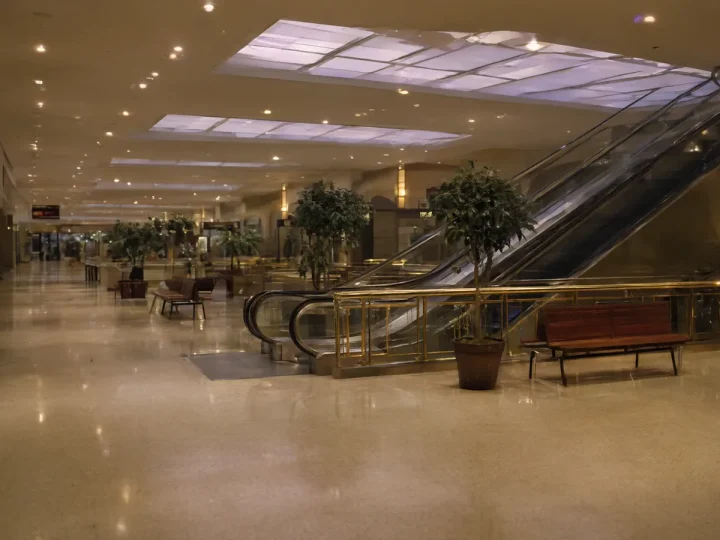
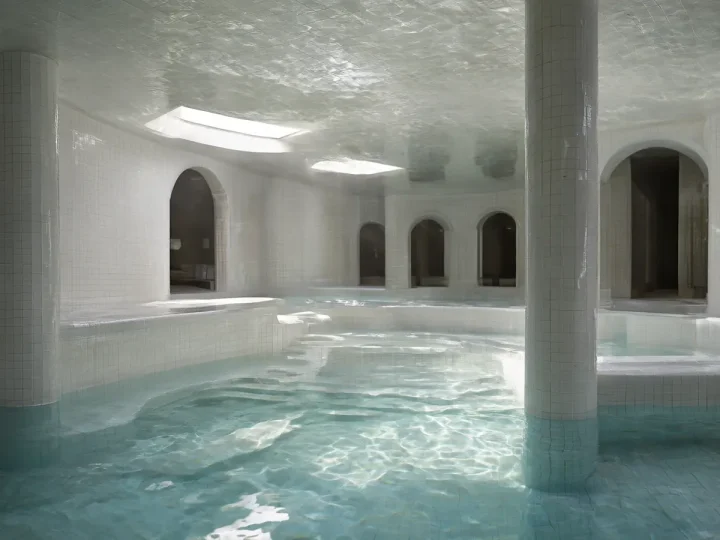
Curated palettes across r/dreamcore and dreamcorearchive lean toward washed-out pastels: airy sky blues, muted meadow greens, blush-pink clouds, and chalky white facades. Early creators often used accessible editing apps such as ibisPaint and Gachalife, blending elements of demoscene, glitch art, 50s/60s vintage collage, and objective surrealism while pushing saturation, blur, and sharpening so lone suburban homes, stitched highways, vacant malls, Backrooms Level 94, or the Poolrooms resemble degraded recollections. Floating red or black questions, blacked-out boxes, checkered floors, sparkles, rainbows, and open skies replacing interior ceilings complete the dream montage.
Unlike unpeopled liminal photography, Dreamcore populates its worlds with recurring inhabitants. Recurring Dreamcore creatures and original characters include:
- Object-headed figures: Humanoids whose heads are swapped for CRT monitors, televisions, mushrooms, plush toys, cakes, or household objects.
- Eye-centered beings: Winged humanoids bearing a single large eye or clusters of eyes, alongside eyed clouds and mushrooms.
- Childhood archetypes: Smiling suns, giant rabbits, distorted cats, clowns, and enigmatic guardians—most famously “mother,” an ambiguous gatekeeper whom the dreamer seldom recognizes.
Commentary on shapes.inc observes that eye-headed and object-headed figures often maintain a quiet, guiding, or childlike symbiotic bond with the viewer. Offscreen, community members brought those OCs into cosplay and fashion rooted in the 2020 alt aesthetic and anime influences such as Danganronpa—combining big cardboard eyes, oversized leg warmers, bunny ears, oversized shirts, kidcore accessories, and custom Roblox avatars, while offering expressive online spaces for LGBTQ+ communities during pandemic lockdowns.
Dreamcore Music, Samples, and Surreal Video Games
Sound carries Dreamcore’s mood as powerfully as pastel lighting. Dreamcore music favors ambient textures, slowed indie pop, VHS-aged synths, and nostalgic game scores. Recurring compilation staples include Molina’s Hey Kids, Kero Kero Bonito’s I’d Rather Sleep, Mild High Club’s Homage, Yungatita’s 7 Weeks & 3 Days, Instupendo’s Comfort Chain, Hisohkah and WMD’s School Rooftop, Toby Fox’s Fallen Down, Susumu Hirasawa’s Parade, Yabujin’s surreal edits (such as Jumping Is Not a Crime), and eccentric tracks by Jack Stauber (including Two Time). Original producers such as Leadwave, Piem Ión, and Samuel Benítez also build bespoke instrumentals for the scene.
Surreal video games supplied both historical blueprints and contemporary showcases. Decades before TikTok tags existed, Japanese surrealist titles—from Yume Nikki (2004) and its fan successor Yume 2kki (2007) back to LSD Dream Emulator (1998) and EarthBound (1994)—trained players to explore disconnected dreamworlds without explicit quests. Starting in 2006, Roblox hosted social dreamlike worlds ranging from Peppers Playhouse and Critterspace to Jovial Playground, A Broken Dream, and Explore Dreamcore/Weirdcore/Backrooms. A newer generation expanded the canon into richly rendered exploration: Superliminal and Smile For Me (2019), OMORI (2020), Anemoiapolis (2023), Montraluz’s psychological horror game Dreamcore (2025), ENA: Dream BBQ (2025), and 2026 releases including Subliminal, Nophenia, Lucid Blocks, and the Y O U demo.
Cinematic Precursors and Cross-Media Liminal Cinema
Dreamlike, spatially unstable environments entered cinema long before hashtags organized them online. Film historians and liminal-space archives point to Stanley Kubrick’s Overlook Hotel in The Shining—deliberately constructed with physically impossible floor plans, overlapping corridors, and cold symmetry that pull the building outside ordinary time—alongside David Lynch’s recurring dream spaces. Lynch’s The Black Lodge in Twin Peaks (1990) and his 2006 experimental feature Inland Empire, filmed entirely with a Sony DSR-PD150 camcorder in standard-definition digital video, established a direct bridge between low-fidelity digital video, dream logic, and uncanny corridors.
Contemporary filmmakers acknowledge those lineages openly. Critic Owen Gleiberman of Variety framed Inland Empire as a direct forebear of the 2026 psychological thriller Backrooms, and in a 2025 interview with Collider, director Kane Parsons credited early exposure to Lynch’s work—recalling how his father decorated their rented home with red curtains and zigzag carpeting modeled on Twin Peaks. Elsewhere across screen culture, director Kyle Edward Ball consulted r/LiminalSpace and r/weirdcore while crafting his 2022 experimental film Skinamarink, television showrunner Dan Erickson acknowledged the Backrooms as an inspiration for Severance, and Genki Kawamura’s 2025 feature Exit 8 (adapted from the 2023 game The Exit 8) translated looping subterranean architecture into theatrical suspense.
Dreamcore vs. Weirdcore and Vaporwave
Because internet aesthetics cross-pollinate constantly—overlapping with related subcultures from Glitchcore, Webcore, and Kidcore to Traumacore, Xpiritualism, Gurokawa, and Yabujincore—viewers frequently conflate Dreamcore with Weirdcore, architectural liminality, or Vaporwave. Setting all four side by side clarifies how each handles memory, technology, and visual mood.
| Aesthetic | Origins & Era | Visual & Lighting Signature | Core Emotional Register | Representative Touchstones |
|---|---|---|---|---|
| Dreamcore | 2018 Tumblr roots; early 2020s TikTok surge | Washed-out pastels, eternal 3 p.m. glow, surreal CGI, object-headed and eyed figures | Comfort, nostalgia, dreamlike detachment, mild derealization | @gbrltvrst, Hayden Clay, Yume Nikki (2004), Dreamcore (2025) |
| Weirdcore | Mid-2010s Tumblr; early 2020s revival | Amateur late-1990s/mid-2000s photos, heavy image compression, word art, awkward framing | Confusion, alienation, dread, and anemoia | Soup 0.9 (2007), Eastern Mind (1994), Aphex Twin, Boards of Canada |
| Liminal Space | 2019 imageboards & 2020 lockdowns (anthropology 1909) | Empty transitional architecture, fluorescent halls, malls, stairwells, zero characters | Kenopsia, architectural uncanny, quiet melancholy | r/LiminalSpace, Backrooms (2019), Exit 8 (2025) |
| Vaporwave | Early 2010s Bandcamp, Reddit, & Tumblr | 1990s web graphics, Greco-Roman busts, Memphis shapes, VHS blur, neon cyan-magenta | Satirical critique of consumer capitalism and retro longing | Chuck Person’s Eccojams Vol. 1 (2010), Far Side Virtual (2011), Floral Shoppe (2011) |
The closest sibling is Weirdcore (also called Oddcore or Strangecore). Emerging on Tumblr during the mid-2010s—while sharing unlabeled affinities with early internet games like Soup 0.9 (2007) and Eastern Mind (1994)—Weirdcore imitates amateur photos and primitive graphics from the late 1990s through the mid-2000s. Heavy image compression, unusual borders, word art, uncomfortably framed subjects, distorted objects, and out-of-context labels withhold orientation to provoke confusion and anemoia (nostalgia for an era never lived). Its musical circle ranges from Aphex Twin and Boards of Canada to pilotredsun, Cyriak, The Future Sound of London, and Leyland Kirby. Dreamcore, though sometimes lo-fi, prefers softer pastels, interactive characters, and the gentler feeling of stepping inside a dream.
Vaporwave—coined from “vaporware” and building on earlier works like the June 2009 audio-visual album Memory Vague—charts an older retro-digital lineage pioneered in the early 2010s by Daniel Lopatin (Chuck Person’s Eccojams Vol. 1, 2010), James Ferraro (Far Side Virtual, 2011), and Ramona Langley (Floral Shoppe, 2011). Gaining wider reach by mid-2012 across Last.fm, Reddit, 4chan, and Bandcamp, Vaporwave drew rapid critical attention: Adam Harper’s December 2012 Dummy essay linked its slowed corporate mood loops to accelerationist theory, Thump asked in late 2013 whether it would become “the next Seapunk,” academic Laura Glitsos noted its fusion of music and visual form, and releases such as Cat System Corp’s News at 11 (2016) probed pre-2001 media memory. Where Vaporwave satirized 1980s–1990s consumer technoculture—and later fractured into subgenres from mallsoft to late night lo-fi—Dreamcore redirects digital nostalgia inward toward personal childhood dreamscapes.
Frequently Asked Questions
Is Dreamcore supposed to be scary?
No. While some Dreamcore videos include eerie captions, voids, or psychological unease, horror is not required. Many works emphasize surreal warmth, childhood nostalgia, humor, and gentle detachment from waking reality.
What is the difference between Dreamcore and Weirdcore?
Dreamcore highlights pastel dream logic, overexposed afternoon skies, ambient pop, and interactive figures such as object-headed or eyed characters. Weirdcore leans more heavily on late-1990s to mid-2000s amateur photography, strong digital compression, and out-of-context captions aimed at confusion, alienation, and anemoia.
Who started the Dreamcore aesthetic?
No single creator founded Dreamcore; it grew collectively across Tumblr, TikTok, YouTube, and Reddit during the late 2010s and early 2020s. Early visual roots trace to 2018 Tumblr posts by @gbrltvrst (Gabrielle Traversat), followed by pandemic creators like @lizardKisses and later CGI artists such as Hayden Clay and @Vaporramavision.
What defines Dreamcore lighting and color palettes?
Archives such as dreamcorearchive define canonical daytime imagery as ‘eternal 3 p.m. lighting’—slightly overexposed whites, nearly textureless skies, and absent cast shadows—paired with washed-out pastel blues, meadow greens, blush pinks, and chalky whites. Nighttime scenes substitute greenish institutional fluorescent lighting.
Sources and Further Reading
- Dreamcore — Aesthetics Wiki (CC BY-SA 3.0; accessed 2026-11-28, rev. 247899)
- Weirdcore — Aesthetics Wiki (CC BY-SA 3.0; accessed 2026-11-28, rev. 247133)
- Liminal space — Wikipedia (CC BY-SA 4.0; accessed 2026-11-28, rev. 1386321934)
- Vaporwave — Wikipedia (CC BY-SA 4.0; accessed 2026-11-28, rev. 1387522911)