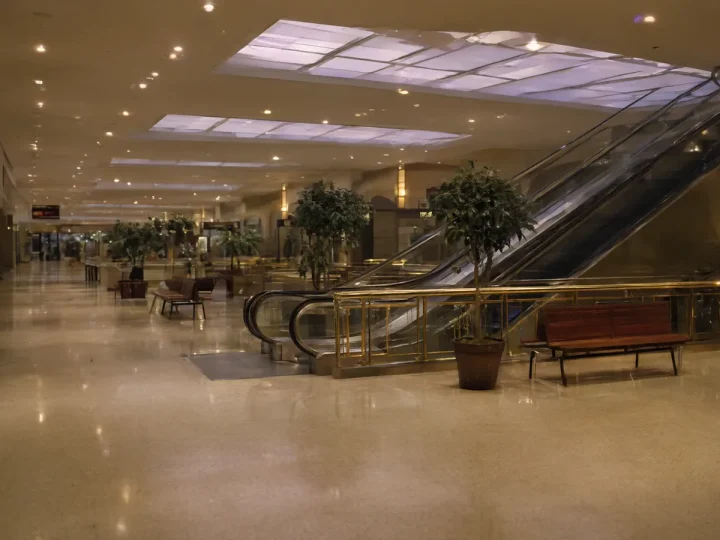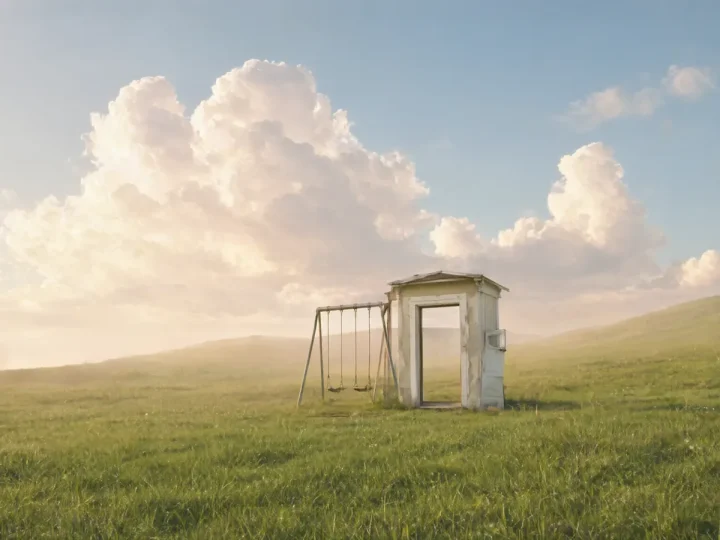
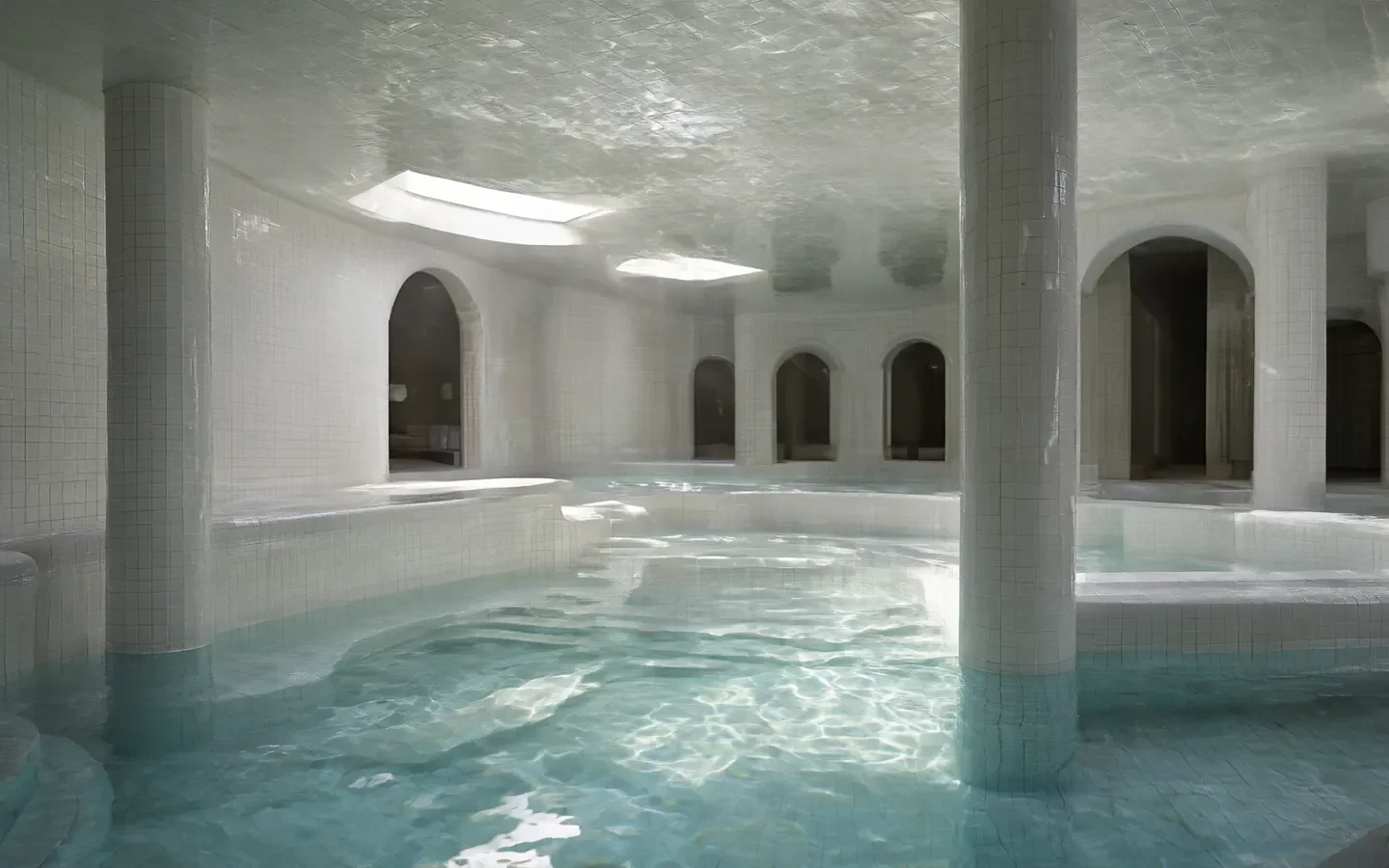
Descending tiled steps into an expansive, windowless complex of vaulted halls submerged in clear turquoise water. Diffused daylight spills from recessed ceiling shafts, throwing pale caustic ripples across immaculate white ceramic grids and curved passages turning out of view—this unmistakable visual image defines the Poolrooms. Neither lifeguards nor swimmers break the stillness, yet every tile gleams as though freshly maintained.
Catalogued across aesthetic archives as Poolcore, Liminal Pool, or Dreampools, this aquatic branch of the wider liminal space movement replaces yellowed office drywall with bright mineral stillness and impossible bathhouse geometry. Whether encountered through real photographs of empty natatoriums, 3D renders, indie exploration games, or Backrooms Level 37 lore, the Poolrooms turn empty indoor water architecture into a meditative labyrinth.
What Are the Poolrooms? Defining Aquatic Liminality
Poolcore centers on vacant aquatic spaces that evoke serenity and eeriness simultaneously. Spotless tilework and cool blue-white palettes radiate calm, hygiene, and shelter, while the complete absence of people, signage, or logical exits introduces kenopsia and subtle disorientation. Unlike ruined abandoned pools marked by rust or cracked concrete, classic Poolrooms imagery appears untouched by decay, suspending the room outside ordinary human time.
Curators distinguish two intersecting visual streams. One consists of real-world photographs showing deserted hotel pools, municipal natatoriums, and closed indoor waterparks. The other—most tightly bound to the name Poolrooms—relies on 3D architectural renders that stretch bathhouse motifs past any practical blueprint into looping corridors, submerged staircases, and oversized vaulted basins.
Jared Pike and the Origins of Poolcore
Careful documentation separates anonymous viral snapshots from verified authorship. Uncredited photographs of quiet indoor pools had circulated on visual blogs since the 2010s, stripped of photographer names or locations; like much internet liminal photography, those stray snapshots lack confirmed creators and should never be falsely attributed.
By contrast, the unmistakable modern architectural look of the Poolrooms carries a documented pioneer: digital artist Jared Pike. Emerging prominently alongside the March 2020 pandemic surge in empty-space aesthetics, Pike’s Dream Pools 3D render series codified the signature motif of small square white tiles wrapping uninterruptedly across floors, arches, pillars, and water-filled chambers. Both Aesthetics Wiki’s Poolcore page and the Backrooms Wiki on Fandom credit Pike as a central creator, with Fandom displaying its Level 37 imagery by permission from jaredpike.art.
Parallel open-licensed communities developed their own visual archives. On the Backrooms Wikidot, the canonical Level 37 article written by egglord (with critique from Sariastuff) pairs its text with four renders—Poolrooms-1.jpg through Poolrooms-4.jpg—contributed by u/AnarkyMusic under a CC BY-SA 4.0 license. Together, credited digital art and community archives propelled the aquatic subgenre alongside the broader liminal wave that pushed r/LiminalSpace past 500,000 members and TikTok’s #liminalspaces past two billion views by November 2022.
Spatial Architecture, Ceramic Surfaces, and Caustic Light
An effective Poolrooms composition relies on strict formal grammar: continuous ceramic grids, sculpted water light, and stripped-down scale cues.
Real public pools rarely tile an entire room; glazed tile normally lines only the basin and splash margins before yielding to plaster walls, painted roof trusses, benches, or depth plaques. Digital Poolrooms erase those civic transitions. Identical square ceramic tiles—chiefly stark white, though Poolcore variations sometimes adopt a darker shade in navy or lighter blue—cover walls, archways, columns, descending staircases, and underwater openings seamlessly. Removing windows, clocks, lane lines, and safety markers deprives the eye of ordinary scale references, leaving repeating grout lines to measure distance alone.
Illumination brings those bare grids alive. Daylight or diffuse overhead fixtures strike clear water and refract into shifting caustic nets across submerged steps and ceiling vaults. Minimalist Poolcore close-ups often frame only light bouncing across tiled pool floors, while wider scenes contrast luminous central chambers against dark, receding tunnels where visibility ends abruptly.
Across visual archives, creators work along a narrow stylistic spectrum: pure white-tiled 3D renders evoke quiet solitude, on-location photographs of empty hotel pools ground that mood in kenopsia, nostalgic waterpark slides nod toward Kidcore, and pink-violet lighting blends aquatic tiles with Vaporwave palettes.
Why Flooded Corridors Feel Both Serene and Unsettling
Several perceptual mechanisms explain why empty tiled water halls hold viewers without monsters or gore. Public swimming facilities follow highly standardized layouts worldwide. Because many people visited near-identical hotel pools, school natatoriums, or recreation centers in childhood, separate memories merge into a single architectural composite. Confronting a stripped tiled basin feels uncannily familiar—as though rediscovering a place visited only in sleep.
That dream resonance links Poolrooms naturally with Dreamcore, since water environments recur frequently in dreams as fluid, boundary-softening spaces. Simultaneously, cool cyan water and spotless white tile signal cleanliness and rest, softening the solitude.
Underneath that calm operate the same psychological tensions defining all threshold environments—tracing back to Arnold van Gennep’s 1909 anthropological model of transitional states and Victor Turner’s analysis of suspended social order. Drawing on Mark Fisher in Pulse: The Journal of Science and Culture, Peter Heft linked the eeriness of empty civic buildings to a “failure of presence.” In 2022, psychologists Alexander Diel and Michael Lewis further demonstrated that subtle architectural deviations—such as stairways dropping straight into dark water or pillars crowded too densely for swimming—trigger an architectural uncanny valley. The room looks hospitable, yet its geometry resists safe human occupation.
Backrooms Level 37 and the Sublimity Lore
Writers on community Backrooms wikis folded the aquatic aesthetic directly into their shared mythos as Level 37, subtitled Sublimity (authored by egglord / Egglord1). Comparing both major community wikis—the Backrooms Wikidot and Fandom wikis—shows how fiction translated Poolcore’s visual stillness into spatial lore.
Both versions depict a sprawling labyrinth of interconnected tiled chambers filled with lukewarm, constantly rippling water whose driving force remains unknown, inspiring wanderer theories about internal tides. Its design appears immaculate yet non-functional: virtually indestructible white tiles prevent digging through walls, thick columns cluster inside open basins without structural purpose, pools lack ledges for climbing out, and stairways descend directly into unlit deep pits posing serious drowning hazards.
Sensory quirks reinforce the paradox. Water samples show traces of magnesium sulfate (Epsom salt) alongside unidentified compounds that relax tired muscles, yet sound behaves abnormally—footsteps and speech die abruptly instead of echoing cleanly off ceramic walls, while water sound swings from quiet stillness to an obtrusive rush that drowns every surrounding cue. Neither canon records hostile entities or permanent human outposts, attributing the solitude to vast scale, isolated geography, and dampened acoustics.
Small canon distinctions separate the two archives:
- Hazard rating: Backrooms Wikidot assigns Level 37 a Survival Difficulty rating of 0—marking it safe and free of entities, though structurally unsecure. The Fandom wiki places it at Threat Index Class 1, categorizing the space as safe and entity-free yet unstable, and adds a footnote warning that isolated water sections contain bacteria such as Legionella and E. coli.
- Connections: Wikidot maps entries through Levels 58, 119, 233, 130, and an arcade on Level 25, with exits leading to Levels 130, 43, and 233. Fandom links entries from Levels 7, 46, 54, and 30, with exits opening onto sublevel 37.1 as well as Levels 330, 4, 43, and 34.
Both files close with an anonymous recovered journal piece titled My Musings, calling each realm a “Scape”—a dreamlike reflection poised between peaceful refuge and the uneasy comparison to a nightmare.
Poolrooms in Interactive Media and Contemporary Visual Culture
Independent games brought static aquatic renders into navigable first-person space. Titles documented across Poolcore archives—The Classrooms (2022), Anemoiapolis (2023), and the stark exploration experience Pools (2024)—proved that flooded ceramic architecture requires no monsters or combat to sustain tension. Wading down submerged steps, watching caustics ripple across arched galleries, and choosing between identical dimly lit turns restores the Poolrooms to their curatorial core: a quiet meditation on light, surface, and spatial solitude.
That same aquatic minimalism echoes across recent liminal-space cinema documented alongside Poolrooms archives. Director Kyle Edward Ball browsed r/LiminalSpace and r/weirdcore while shaping his 2022 horror feature Skinamarink, director Genki Kawamura adapted the 2023 indie hit The Exit 8 into the 2025 theatrical release Exit 8, and Kane Parsons expanded his Backrooms shorts into an A24 feature released in 2026—a project Parsons linked in a 2025 Collider conversation to early exposure to David Lynch, and which Variety critic Owen Gleiberman connected back to Inland Empire. Across interactive renders and films alike, empty architectural space carries both eerie tension and peaceful fascination.
Frequently Asked Questions
Are the Poolrooms a real physical place you can visit?
No endless indoor tiled complex matching the Poolrooms exists in reality. While Poolcore photography documents real deserted hotel pools and closed waterparks, the iconic white-tiled labyrinths popularized online originate from 3D architectural art, digital renders, and indie exploration games.
Who created the Poolrooms aesthetic?
Early online snapshots of empty pools circulated anonymously during the 2010s without a single founder. However, digital artist Jared Pike is widely credited with establishing the defining white-tiled 3D Poolrooms vocabulary through his Dream Pools renders, alongside contributors like u/AnarkyMusic on Wikidot and Level 37 author egglord.
What is the difference between Poolrooms and Poolcore?
Poolcore denotes the broader aesthetic covering real pool photographs, close-up water reflections, nostalgic waterparks, and Vaporwave color shifts. Poolrooms specifically describes enclosed, seemingly endless white-tiled indoor water labyrinths closely tied to Backrooms Level 37.
Sources and Further Reading
- Liminal space — Wikipedia (CC BY-SA 4.0; accessed 2026-11-28, rev. 1386321934)
- Poolcore — Aesthetics Wiki (CC BY-SA 3.0; accessed 2026-11-28, rev. 241799)
- Level 37 (Sublimity / Poolrooms) — Backrooms Wikidot (CC BY-SA 3.0; accessed 2026-11-28)
- Level 37 — Backrooms Wiki (CC BY-SA 3.0; accessed 2026-11-28, rev. 1393727)