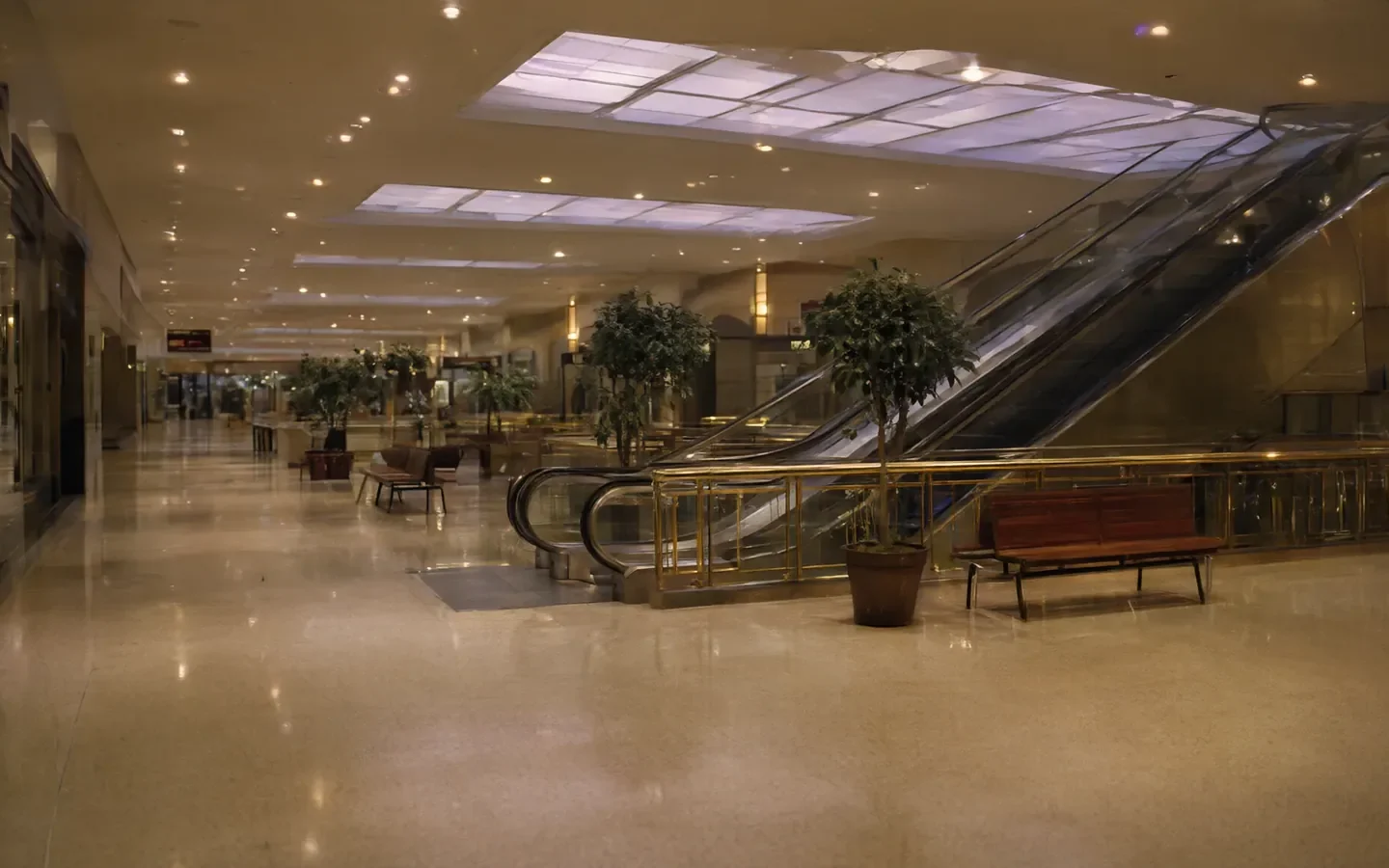
Step into a closed shopping concourse twenty minutes after the last security gate drops, or pause mid-flight on an empty hotel stairwell where humming recessed tubes wash faded carpeting in pale yellow light. Nothing visibly threatens you, yet the room refuses to feel ordinary. That charged hush defines a liminal space—an architectural and psychological threshold where a familiar built environment stands emptied of human routine, hovering between past use and future arrival.
In visual culture, the phrase operates across two converging domains. Within anthropology, liminality designates an in-between phase of transformation. Across digital archives, photography boards, and indie media, however, the label has expanded into an aesthetic centered on deserted corridors, waiting bays, shuttered malls, after-hours classrooms, empty parking decks, and surreal 3D interiors. Curated together, these frames read like exhibition plates of modern architecture caught off duty—simultaneously nostalgic, tranquil, and quietly disorienting.
What Is a Liminal Space? Defining the Threshold
The adjective liminal descends from the Latin noun limen, denoting a doorway sill or physical threshold. Strictly speaking, a transitional zone is built for movement rather than permanence: airport concourses, highway rest stops, subway transfers, motel breezeways, lobbies, and stairwells. People cross them daily without treating them as destinations.
Online curators broadened that scope considerably. Digital collections gather not only literal thoroughfares but also familiar venues stripped of the people, sound, and social schedule that normally anchor them. A quiet school hall over summer recess, a vacant banquet room, or a deserted indoor playground can register just as vividly. Once human activity vanishes, dropped ceilings, patterned carpets, fluorescent fixtures, and repeating doorframes step forward from the background and carry the entire frame.
Because each viewer supplies a personal archive of comparable rooms, emotional responses diverge sharply. One observer inspecting an empty concourse feels soothing melancholy and childhood memory; another senses vertigo, grief, or creeping unease. Rather than reducing empty architecture to pure horror, strong threshold imagery holds comfort and estrangement in balance.
Anthropological Roots in Van Gennep and Turner
Long before social feeds catalogued vacant hallways, anthropologists established liminality as a formal tool for analyzing human transition. Folklorist Arnold van Gennep introduced the framework in his 1909 monograph Les rites de passage, arguing that cultural passages share a recurring three-part sequence:
- Preliminal rites (separation): Participants break away from a prior social status, habitat, or daily routine.
- Liminal rites (transition): Initiates cross the threshold itself, occupying an ambiguous interval governed by ritual order and ceremonial oversight, having left an old role without yet assuming a new one.
- Postliminal rites (incorporation): Participants re-enter social life bearing a newly recognized status.
British anthropologist Victor Turner rediscovered van Gennep’s study in 1963 and broadened its scope through fieldwork among the Ndembu in Zambia, culminating in The Forest of Symbols (1967) and his essay Betwixt and Between. Turner observed that threshold figures—liminal personae—experience a temporary dissolution of rank and habit. Within that suspension, shared solidarity can crystallize into communitas (spontaneous, ideological, or normative). To distinguish voluntary post-industrial cultural experiences such as art and theater from binding tribal rites, Turner also coined the adjective liminoid.
Later scholars noted that suspension is not always regenerative. Agnes Horvath argued in 2013 that prolonged crisis liminality—during societal collapse or political upheaval, when no ceremonial guide promises closure—can generate intense anxiety and existential dread. Depth psychology drew parallel insights: Jungian theorists compare individuation to crossing a threshold within a protected container (a temenos), while cautioning against lingering indefinitely outside ordinary structure. Calendar boundaries exert an analogous pull: twilight, midnight, equinoxes, solstices, and New Year’s Eve feel suspended because one interval has closed before the next stabilizes.
Psychology of Empty Rooms and Kenopsia
Standing before a photograph of a deserted mall or windowless hallway activates several interlocking perceptual cues. Curators frequently invoke kenopsia—the eerie, poignant stillness felt inside a space engineered for lively crowds when every corridor and bench lies abandoned. Rather than registering neutral vacancy, the brain detects an active contradiction between architectural design and lived presence.
Writing in Pulse: The Journal of Science and Culture and building on theorist Mark Fisher’s study of the eerie, Peter Heft linked this chill to a “failure of presence.” An empty forest rarely disturbs us because no social script expects crowds beneath the trees. A brightly lit school corridor or civic waiting room, by contrast, announces human purpose through lockers, signage, and seating; when nobody inhabits it, the interior feels detached from its rightful context.
Empirical research supports this spatial friction. Research published by Alexander Diel and Michael Lewis in 2022 showed that subtle deviations from familiar architectural grammar—atypical doorway proportions, endless modular repetition, irregular light, or illogical layouts—can evoke an architectural uncanny valley. The room looks nearly conventional enough to reassure perception, yet minor geometric mismatches block effortless recognition.
Biographical memory supplies the final emotional resonance. Mass-built commercial and institutional interiors of the late twentieth century relied on interchangeable templates: acoustic ceiling tiles, terrazzo concourses, modular fluorescent troffers, brass handrails, and industrial carpet. Because millions passed through nearly identical clinics, motels, and schools while growing up, an unpeopled photograph stripped of identifiable logos functions as an open screen onto which viewers project half-remembered moments.
Spatial Architecture, Lighting, and Material Surfaces
Examined through a curatorial lens, compelling threshold scenes depend on concrete formal decisions—geometry, illumination, and surface finish—rather than vague atmosphere.
| Spatial Archetype | Architectural Geometry | Lighting Regime | Signature Surfaces | Dominant Affect |
|---|---|---|---|---|
| Corridors and Stairwells | Long axial vanishing points, repeating doors, blind perpendicular turns | Overhead cool or yellowed fluorescent tubes with uneven shadow pools | Acoustic drop ceilings, low-pile carpet, painted masonry, rubber trim | Disorientation and suspended movement |
| Commercial atriums and dead malls | Multi-story balconies, halted escalators, wide symmetrical concourses | Fading skylight twilight balanced against warm tungsten downlights | Polished terrazzo, brass railings, stucco piers, indoor planters | Kenopsia and bittersweet nostalgia |
| Institutional Rooms | Windowless waiting bays, grid-aligned classrooms, locker-lined halls | Flat overhead fluorescent banks casting a greenish or sterile tint | Waxed linoleum, laminate desks, pale painted drywall | Failure of presence and quiet unease |
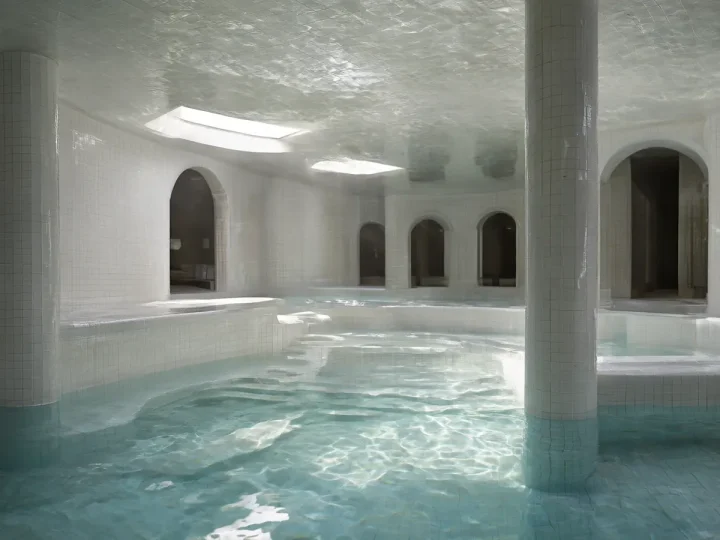
| Aquatic chambers | Submerged stairways, rounded archways, columned shallow basins | Diffused ceiling daylight shafts projecting caustic water ripples | Glossy white square ceramic tile, reflective blue-green water | Serenity braided with isolation |
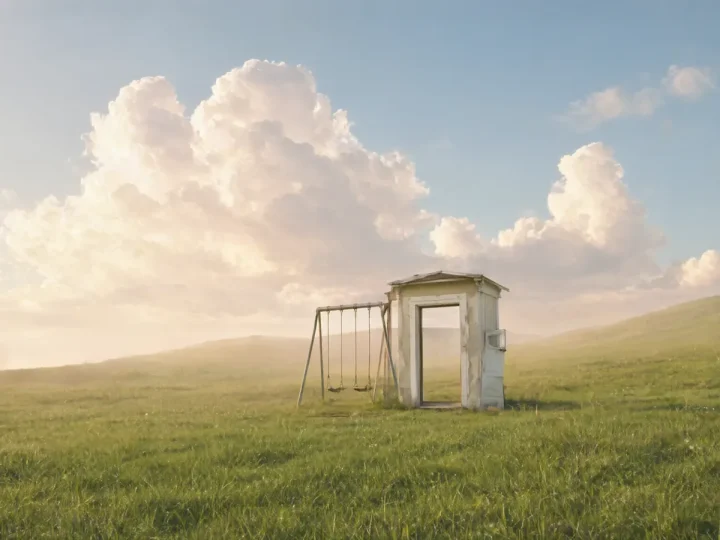
| Digital and dreamlike landscapes | Disconnected roads, solitary houses on smooth hills, impossible horizons | Overexposed afternoon haze with softened or missing cast shadows | Low-resolution textures, compressed digital grain, pastel skies | Derealization and childhood memory |
Photographic technique amplifies these material cues. The widely shared flash-photo aesthetic fires harsh on-camera flash into darkened rooms, illuminating foreground carpet pile and dust while letting receding doorways fall into flat darkness. Low-resolution grain, muted tonal shifts, and a slight Dutch angle echo early consumer digital cameras from the late 1990s and early 2000s, giving contemporary scenes the patina of recovered archival evidence.
Internet Origins From 2019 Imageboards to Lockdowns
Although photographers and filmmakers had studied vacant interiors for decades, the named online aesthetic coalesced rapidly during 2019 across 4chan, Reddit, and Tumblr. Users began collecting stray snapshots—old real-estate photos, municipal records, after-hours workplace shots, and early family digital files—that seemed oddly severed from everyday context.
One imageboard post proved decisive. On May 12, 2019, an anonymous poster on 4chan’s /x/ board asked users for unsettling pictures that simply felt “off,” sharing a tilted interior view of a windowless, partitioned room covered in damp carpet beneath yellowed fluorescent lighting. Another anonymous contributor named the setting the Backrooms, imagining roughly six hundred million square miles of haphazardly partitioned rooms entered by noclipping past everyday reality. Within days, stories flourished on r/creepypasta and r/backrooms before branching into collaborative Wikidot and Fandom wikis—though purists led by Reddit user LitheBeep founded r/TrueBackrooms to preserve the minimalist original mood. By March 2022, r/backrooms exceeded 157,000 members.
Curating viral threshold imagery requires strict honesty regarding provenance. Many circulating photographs remain anonymous, stripped of camera metadata and original uploaders, and responsible archives refuse to invent credits where none exist. The original Backrooms photograph demonstrates both anonymous viral drift and rigorous verification. Its origin remained anonymous until May 2024, when a Backrooms Discord group traced the file through the Wayback Machine to a March 2, 2003 renovation blog. Uploaded as Dsc00161.jpg, the shot was taken on June 12, 2002 with a Sony Cyber-shot camera during second-floor remodeling at 807 Oregon Street in Oshkosh, Wisconsin—previously Rohner’s Home Furnishings before HobbyTown leased the storefront. Captioned “the East (Oval) room,” the water-damaged interior no longer survives in that layout, having been converted into a radio-controlled car track. After the 2024 identification, the owner launched a crowdfunding appeal toward an estimated $78,000 roof repair, raising over $24,000 before selling the property and shop in 2025.
Global circumstances soon carried the aesthetic far beyond niche forums. Starting in March 2020, COVID-19 lockdowns emptied transit terminals, universities, office towers, and shopping malls worldwide, giving millions direct lived contact with kenopsia. By November 2022, TikTok clips tagged #liminalspaces had cleared two billion views, Twitter curator @SpaceLiminalBot counted more than 1.2 million followers, and Reddit’s r/LiminalSpace had grown past 500,000 subscribers.
Poolrooms and Dreamcore as Sister Archives
As online collections expanded, distinct sub-archives diverged by surface palette, emotional temperature, and narrative presence. Two major sister territories illustrate how widely threshold principles travel beyond beige drywall.
The first is the aquatic labyrinth of the Poolrooms, closely aligned with Poolcore and aquatic Backrooms interpretations. Trading yellowed fluorescent halls for spotless white ceramic tiles, overhead skylight shafts, and shimmering turquoise water, these flooded bathhouse interiors pivot toward calm reflection while retaining uncanny architectural impossibility.
The second is Dreamcore, a surrealist internet aesthetic that transforms deserted rooms and rolling hills into nostalgic dream stages. Where pure liminal photography removes every figure from sight, Dreamcore layers overexposed pastel daylight, lo-fi text, and symbolic or object-headed inhabitants that speak straight to the viewer.
Adjacent scholarly concepts also frame this archive: urban historians link empty retail plazas to dead malls, cultural theorists connect transit zones to non-places and heterotopias, and digital media critics trace how degraded VHS texture bridges liminal interiors with analog horror.
Liminal Architecture in Cinema, Television, and Games
Cinema harnessed impossible interiors well before imageboards named the mood. In Stanley Kubrick’s The Shining, the Overlook Hotel was deliberately built with dead-end hallways and overlapping rooms that defeat any coherent floorplan, while Kubrick’s clinical symmetry suggests a structure detached from normal time. David Lynch likewise pioneered dreamlike threshold staging through the red-curtained Black Lodge in Twin Peaks (1990) and his experimental film Inland Empire (2006), shot entirely on standard-definition Sony DSR-PD150 digital video—a low-fidelity precedent that Variety critic Owen Gleiberman cited as an ancestor to 2026 psychological horror.
That visual heritage converged directly with internet-native filmmaking in January 2022, when 16-year-old Northern California creator Kane Parsons (Kane Pixels) released The Backrooms (Found Footage) on YouTube. Built over one month with Blender and Adobe After Effects, the short passed 90 million views by August 2026, grew into a 25-episode web series totaling over 197 million views, won a 2022 Streamy Creator Honors award, and led to A24’s theatrical Backrooms adaptation, which opened across U.S. cinemas on May 29, 2026. Speaking with Collider in 2025, Parsons recalled growing up amid red curtains and chevron carpeting after his father decorated a rented house in homage to Lynch’s Twin Peaks.
Other directors and showrunners drew openly from online threshold communities. Kyle Edward Ball browsed r/LiminalSpace and r/weirdcore while shaping his 2022 nocturnal horror feature Skinamarink. Dan Erickson, showrunner behind Severance (2022), similarly acknowledged the Backrooms as one of the inspirations for the drama’s sterile, maze-like office halls. Anthology series American Horror Stories premiered an October 2024 episode titled Backrooms starring Michael Imperioli, while Japanese indie hit The Exit 8 (2023) was adapted into Genki Kawamura’s 2025 feature film Exit 8, centered on a looping pedestrian subway corridor.
Interactive games proved especially potent for architectural suspense because first-person movement lets players gauge distance, silence, and false exits directly. Releases including Escape the Backrooms and The Backrooms 1998 (both 2022) and Argentinian studio Montraluz’s psychological exploration title Dreamcore (2025) turned static frames into playable labyrinths. Critics repeatedly pointed to restraint as the source of their longevity: Paste writer Phoenix Simms linked sickly yellow interiors and games like The Stanley Parable to a deep lineage of spatial dread; PC Gamer drew parallels to the cyclopean architecture of R’lyeh in H. P. Lovecraft’s fiction and the vast megastructure depicted in the manga Blame!; and both Kotaku and Curtin University scholar Tama Leaver observed that empty rooms unsettle audiences precisely because they invite viewers to imagine what waits beyond sight.
Frequently Asked Questions
What does liminal space mean in psychology and anthropology?
In anthropology, Arnold van Gennep (1909) and Victor Turner (1967) framed liminality as the ambiguous threshold phase within a rite of passage, situated after departing an earlier social status and prior to entering a new one. In psychology, empty transitional interiors evoke kenopsia, Mark Fisher’s idea of a failure of presence, and—according to Alexander Diel and Michael Lewis’s 2022 study—an architectural uncanny valley triggered by structural deviations.
Why do empty rooms and corridors feel both nostalgic and eerie?
Standardized twentieth-century spaces—schools, malls, motels, and waiting rooms—share visual templates tied to everyday memory. Emptied of crowds and context, those familiar rooms prompt viewers to project personal recollections while simultaneously signaling that expected human life is absent, blending comfort with unease.
What is the verified origin of the original Backrooms photograph?
After circulating anonymously from a May 12, 2019 4chan thread, the photo was traced in May 2024 by a Discord research community using the Wayback Machine to a March 2, 2003 renovation blog. Captured on June 12, 2002 with a Sony Cyber-shot camera as file Dsc00161.jpg, it shows second-floor renovations at 807 Oregon Street in Oshkosh, Wisconsin, where Rohner’s Home Furnishings was transitioning into a HobbyTown store.
How is a liminal space different from Poolrooms or Dreamcore?
Liminal space serves as the umbrella architectural aesthetic encompassing deserted transitional or out-of-context environments. Poolrooms narrow that focus to serene yet labyrinthine white-tiled indoor water halls, while Dreamcore layers pastel skies, surreal edits, lo-fi captions, and symbolic characters atop transitional scenes.
Does every liminal space photo have to be scary or horror-themed?
No. Although horror films and indie games popularized eerie fluorescent corridors and impossible floorplans, many archived photographs and 3D scenes emphasize quiet stillness, bittersweet nostalgia, or contemplative calm without threat or monsters.
Sources and Further Reading
- Liminal space — Wikipedia (CC BY-SA 4.0; accessed 2026-11-28, rev. 1386321934)
- Liminality — Wikipedia (CC BY-SA 4.0; accessed 2026-11-28, rev. 1388435103)
- The Backrooms — Wikipedia (CC BY-SA 4.0; accessed 2026-11-28, rev. 1387336964)
- Valencia, Nicolás (February 22, 2023), “Why Are Liminal Spaces Eerie? The Case of The Backrooms,” ArchDaily; RAMCPU (May 2, 2021), “Liminal Spaces – Lost in Unknowable Loneliness of Modern Architecture,” Sabukaru.